Become Someone Else for a While
It is commonly believed that becoming more informed makes us smarter. But if gaining more knowledge doesn't lead to positive action, how effective is this approach to developing intelligence?
Perhaps the problem isn't how much information we have, but how we use it. What prevents our intelligence from working as effectively as it could? And can we change that?
Who, Why, and How
Have you ever caught yourself thinking:
I can't do it.
I don't know what to do.
It's beyond my control.
Perhaps your intelligence simply isn't finding enough possibilities.
If so, it may be time to expand its capabilities — and learn how to use them.
The Basic Idea
There are many different kinds of people in the world, with many different Types of Thinking and Action (TTA).
Your TTA is just one of them.
Imagine you've mastered another TTA — one that's completely different from your own. Now you have two distinct TTAs.
And what's more, the combination of these two will give rise to a third — your very own TTA, unlike anyone else's.
And that's when you become someone truly unique.
Who Is This For?
A cleaner or a banker. A shop assistant or a spy.
Anyone who has ever thought, "I can't do it," "I don't know what to do," or "It's beyond my control."
Can Critical Thinking Solve This Problem?
Critical thinking helps us evaluate options, identify mistakes, and refine decisions. But repeatedly examining our options doesn't necessarily take us beyond the limits of our current TTA. Different possibilities may still be generated and evaluated according to the same underlying rules.
Critical thinking is valuable, but it cannot replace a change in the way we generate possibilities.
Two Mechanisms of Intellectual Activity
Binary Mechanism
Based on the available information, options are generated and evaluated within the limits of a single TTA. The most suitable option is selected, and a decision is made.
Nonbinary Mechanism
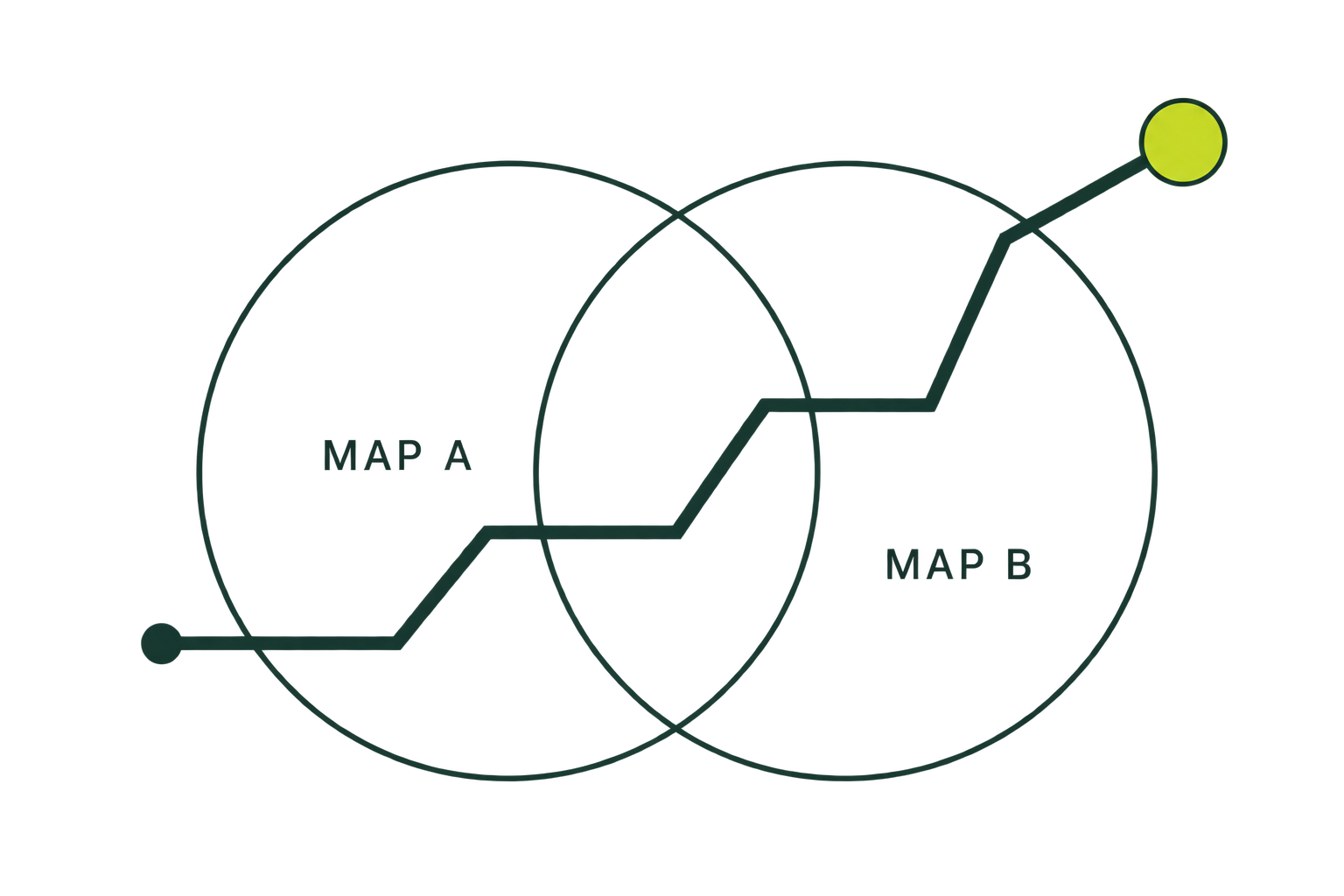
A nonbinary TTA enables intelligence to use the principles and rules of different TTAs to generate and evaluate possibilities — including TTAs that no one else has.
Starting with the available information, an initial option is generated. It can then be transformed through successive steps, drawing on elements of different TTAs.
This process produces new configurations that are not available within any of the original TTAs on their own.
Practical Significance
The nonbinary mechanism expands a person's capabilities beyond familiar solutions and creates the conditions for new, positive actions to emerge.
How Does a Nonbinary TTA Emerge?
How to Master Another TTA
There are two ways to master another TTA:
After all, a different TTA means a different kind of person.
The mental approach is easier; direct action is more reliable. Still, it's better to start with the mental approach: it gives you a chance to get used to living by different rules without changing anything in your actual life.
Direct action can be the next step.
Make an Agreement with Your Own Intelligence
But if you can't become someone else even in your imagination, you're unlikely to do so in real life simply by wishing for it.
And that raises an interesting question: who's in charge of your mind if you can't reach an agreement with your own intelligence?
An agreement, mind you. Not an order.
The Difference Between Knowing and Accepting
Of course, circumstances may force you to act differently. But that doesn't mean you've mastered and accepted another TTA.
For intelligence, knowing something and accepting it are not the same thing.